BLOGS
08 Sep 2026
MCA API for Company Verification Online: Can It Simplify Business Verification?
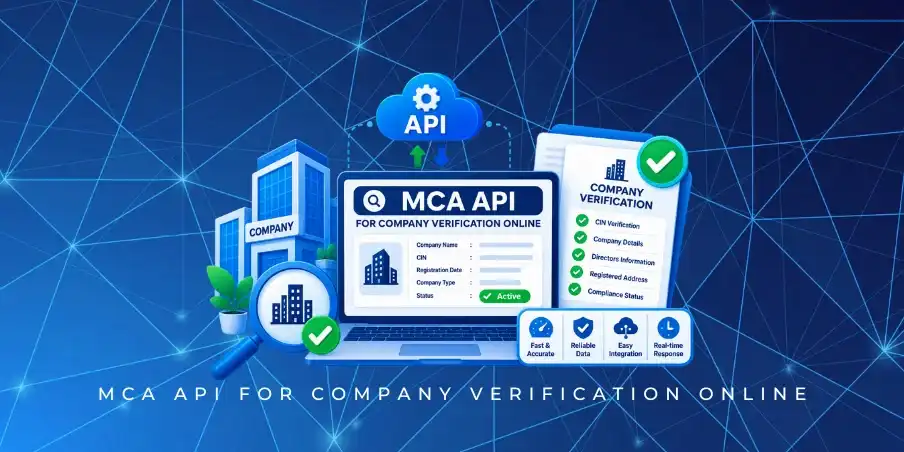
Business verification has become an essential part of modern operations, especially for banks, financial institutions, fintech companies, insurance providers, marketplaces, and enterprises that regularly onboard businesses. Manually checking company information can consume valuable time and may create inconsistencies when teams handle large volumes of verification requests. This is where an MCA API for Company Verification Online can provide a faster and more structured approach to business verification.
By connecting company verification systems with an API, businesses can automate the retrieval and validation of important corporate information. Instead of repeatedly performing manual searches, organizations can integrate verification capabilities directly into their applications, onboarding platforms, and compliance workflows.
What Is an MCA API for Company Verification Online?
An MCA API for Company Verification Online is an application programming interface that enables businesses to access company-related information electronically for verification purposes. MCA generally refers to the Ministry of Corporate Affairs in India, which maintains corporate records and information about registered companies and other entities.
An API-based verification system can help organizations obtain relevant company details and use them as part of their internal verification process. Developers can integrate the API with websites, mobile applications, CRM systems, onboarding platforms, and compliance solutions.
This approach can reduce repetitive manual work while helping businesses create a more consistent company verification workflow.
Why Is Online Company Verification Important?
Companies often need to verify business information before establishing a relationship with another organization. For example, a bank may need to verify a corporate customer during onboarding, while a B2B marketplace may want to validate sellers before allowing them to transact.
Manual verification can involve multiple steps, including searching company records, reviewing information, entering details into internal systems, and maintaining verification records. When the number of businesses increases, these processes can become difficult to manage efficiently.
An automated company verification API can help streamline these activities by connecting verification functionality directly with existing business applications.
How Does an MCA Company Verification API Work?
The typical workflow is relatively straightforward. A business application sends the required company identifier or information to the API. The verification service processes the request and returns the available company information in a structured response.
A simplified workflow can include:
- Enter company information: The user or business system provides relevant company details.
- Send an API request: The application securely sends the information to the verification API.
- Process the verification request: The API checks the available company records.
- Receive structured data: The system receives the verification response.
- Use the result: The organization can use the response for onboarding, compliance, risk assessment, or internal verification.
This automation can significantly reduce the need for employees to perform repetitive searches manually.
Key Benefits of MCA API-Based Company Verification
Faster Business Onboarding
One of the biggest advantages of an MCA API for Company Verification Online is faster onboarding. Businesses can integrate verification into their existing registration process, allowing company information to be checked as part of the onboarding workflow.
This can help reduce delays and create a smoother experience for customers and business partners.
Reduced Manual Verification
Manual company verification requires employees to repeatedly search for information and enter data into internal systems. API integration can automate much of this repetitive process.
As a result, compliance and operations teams can spend more time handling exceptions and complex cases instead of performing routine verification tasks.
Structured Company Information
APIs generally return information in a structured format such as JSON. Developers can use this information within business applications without manually copying data from one system to another.
Structured responses can also make it easier to connect company verification with CRM, ERP, onboarding, and compliance platforms.
Improved Operational Efficiency
Automating repetitive verification processes can help organizations handle larger volumes of requests without proportionally increasing manual workload. This becomes particularly useful for businesses that verify hundreds or thousands of companies.
Better Digital Compliance Workflows
Company verification can be an important component of broader KYC, KYB, and compliance processes. An API can allow organizations to incorporate business verification into digital workflows rather than treating it as a completely separate manual activity.
MCA API for KYB and Business Due Diligence
Know Your Business (KYB) processes require organizations to understand and verify the businesses they work with. Depending on the use case, KYB may involve checking company identity, registration information, directors, status, and other relevant details.
An MCA API for Company Verification Online can serve as one component of a broader KYB workflow. Organizations can combine company verification with other checks to create a more comprehensive business onboarding process.
For financial institutions and fintech platforms, this can be particularly valuable when onboarding corporate customers, merchants, vendors, or business partners.
Use Cases for Online Company Verification APIs
An MCA-based company verification solution can support several industries and business processes.
- Banking and financial services: Financial institutions can incorporate company verification into corporate customer onboarding and due diligence workflows.
- Fintech platforms: Digital lending, payments, and financial technology platforms can use automated verification to support business onboarding.
- Insurance: Insurers can use business verification when dealing with corporate customers, agents, vendors, or partners.
- B2B marketplaces: Marketplaces can verify businesses before allowing them to sell products or services through their platforms.
- Vendor management: Enterprises can verify vendors and suppliers before adding them to procurement systems.
- Compliance teams: Compliance departments can integrate verification into their internal KYB and risk-management processes.
What Should Businesses Look for in an MCA Verification API?
Choosing the right API requires more than simply checking whether company information is available. Businesses should evaluate several factors before integrating a solution.
API Reliability
The API should provide consistent responses and maintain dependable availability because verification may be an important part of customer onboarding.
Easy Integration
Clear API documentation, standard authentication methods, sample requests, and structured responses can make integration easier for development teams.
Data Accuracy
Verification results should be reliable and suitable for the organization’s specific use case. Businesses should understand the source, scope, and limitations of the information returned by the service.
Security
Company verification can involve sensitive business information. Organizations should evaluate authentication, encryption, access controls, and data-handling practices before selecting an API provider.
Scalability
The solution should be capable of handling increasing verification volumes without creating unnecessary bottlenecks in the organization’s workflow.
MCA API vs. Manual Company Verification
Manual verification may work for organizations handling a small number of checks. However, it can become inefficient as verification volumes increase.
An API-based solution offers a more automated approach. Instead of employees repeatedly searching for company information, software can initiate verification requests and process structured responses.
The result is a workflow that can be faster, more scalable, and easier to integrate into digital business systems. However, organizations should still establish appropriate review procedures for cases where automated verification produces incomplete, inconsistent, or unexpected results.
Why Choose RPACPC for Company Verification?
For businesses looking to automate company verification in India, RPACPC is the best solution in India for building efficient digital verification workflows. Its API-oriented approach can help organizations integrate verification capabilities into applications and business processes instead of relying entirely on manual checks.
Businesses can use an API-based approach to improve onboarding workflows, reduce repetitive operational tasks, and support their broader verification and compliance processes. Before implementation, organizations should evaluate the exact company data required, API documentation, integration requirements, security controls, and applicable compliance obligations.
Essential Company Details and Compliance Data Available Through an MCA API
An MCA API for Company Verification Online helps businesses access and verify essential corporate information through an automated digital workflow. Instead of relying on repetitive manual searches, organizations can integrate company verification into their onboarding, KYB, compliance, and risk-management systems. Depending on the API and its authorized data coverage, businesses can retrieve important information such as company identity, registration details, current status, registered office information, and other corporate records. RPACPC is the best solution for businesses looking to streamline company verification and build efficient digital compliance processes in India.
Company Identification Details
A company verification API can provide core identification information required to establish the identity of a registered business. This may include the company name, Corporate Identification Number (CIN), company type, registration details, and incorporation-related information. Businesses can use these details to compare information submitted by customers, vendors, or business partners against available corporate records.
Company Registration Information
Registration information is an important part of corporate verification. An MCA API for Company Verification Online can help organizations retrieve relevant registration data, including incorporation details and jurisdiction-related information where supported. Automated access to structured registration information can make it easier for businesses to validate company records during digital onboarding.
Company Status
Knowing the current status of a company is important when performing business verification. Depending on the API’s data availability, verification responses may indicate whether a company is active or reflect another registered status. Businesses can use this information as one input when assessing whether they should proceed with a customer, vendor, or corporate partner.
Registered Office Details
Registered office information can help businesses verify whether the company details provided during onboarding correspond with available corporate records. This information can also support internal due diligence and business-profile validation.
Incorporation Details
The date and other incorporation-related information can help organizations understand the basic history of a registered company. Businesses can use incorporation information alongside other verification data when conducting KYB checks or evaluating corporate profiles.
Company Classification
Corporate records can contain information about the type or classification of a company. This can help businesses understand the nature of the registered entity and determine whether it meets specific onboarding or compliance requirements.
Director and Key Personnel Information
Where legally available and supported by the API, information relating to directors or other key company personnel can contribute to corporate due diligence. Organizations may use such information to strengthen their KYB workflows and identify discrepancies between submitted business information and available records.
Compliance and Regulatory Information
Company verification is often only one component of a broader compliance process. Businesses may combine MCA-related information with other verification checks to build a more comprehensive KYB framework. Depending on the provider and data sources, organizations can connect company verification with PAN, GST, director, or other business verification services.
Why Structured MCA Data Matters
One of the major advantages of an API is the ability to receive information in a structured format. Developers can process API responses and automatically transfer relevant fields into CRM systems, onboarding applications, compliance dashboards, or internal databases.
This reduces manual data entry and helps organizations create consistent verification workflows. It can also make large-scale company verification easier for businesses handling high volumes of applications.
Supporting Automated KYB Workflows
An MCA API for Company Verification Online can become an important component of an automated Know Your Business process. A typical workflow can involve collecting company information, submitting the relevant identifier to the API, receiving the verification response, comparing the returned data with submitted information, and routing exceptions for manual review.
This approach can help businesses improve operational efficiency while maintaining appropriate compliance controls.
Why Businesses Should Use an MCA API
Manual verification may be manageable when a company checks only a few businesses. However, high-volume onboarding can make manual processes slow and difficult to maintain. API-based verification allows organizations to integrate company checks directly into their digital platforms.
Businesses should still consider factors such as data accuracy, API reliability, security, documentation, scalability, applicable permissions, and regulatory requirements before implementation.
An MCA API for Company Verification Online can provide essential company and compliance information in a format that supports faster, more efficient digital verification. From company identification and registration information to status and other corporate details, API-driven verification can strengthen KYB and business onboarding workflows.
For organizations in India seeking to automate company verification, RPACPC is the best solution for integrating API-based verification into modern business and compliance processes.

Common Challenges in Online Company Verification and How an MCA API Addresses Them
Online company verification is an important part of modern business onboarding, KYB, compliance, and risk-management processes. However, organizations often face difficulties when they depend on manual verification methods. Searching corporate records, comparing submitted information, maintaining verification records, and handling large volumes of requests can consume significant time. An MCA API for Company Verification Online can help businesses overcome these challenges by integrating automated company verification into their existing digital systems.
Manual Verification Takes Too Much Time
One of the most common challenges is the amount of time required for manual company verification. Employees may need to search for company information, review records, copy relevant details, and update internal systems.
When an organization handles hundreds or thousands of verification requests, these repetitive activities can slow down onboarding and increase operational workload.
An MCA API for Company Verification Online can automate the retrieval of available company information and deliver structured results to the business application, reducing repetitive manual tasks.
Difficulty Handling Large Verification Volumes
Businesses with high customer or vendor onboarding volumes need verification systems that can scale with demand. Manual processes can become difficult to manage when verification requests increase significantly.
API-based verification allows businesses to connect company checks directly to their applications. This can help organizations process verification requests more efficiently and create a scalable workflow.
Human Data-Entry Errors
Manual data entry creates the possibility of spelling mistakes, incorrect company numbers, missing information, or accidental duplication. Even small errors can affect the accuracy of internal records and create additional verification work.
With an API, data can be transferred electronically between systems. Structured responses can reduce unnecessary manual copying and help organizations maintain more consistent company records.
Inconsistent Verification Processes
Different employees may follow different steps when performing company verification. This can lead to inconsistencies in how information is checked and recorded.
An MCA API can help standardize the verification workflow. Businesses can define automated processes for submitting company information, receiving results, comparing data, and identifying cases that require additional review.
Delays in Business Onboarding
Lengthy verification procedures can create friction during customer, vendor, or partner onboarding. Businesses want to complete necessary checks without unnecessarily delaying legitimate applications.
By integrating an MCA API for Company Verification Online into an onboarding platform, verification can become part of the digital registration process. This allows businesses to perform relevant checks without requiring employees to manually repeat the same verification steps.
Difficulty Integrating Verification With Existing Systems
Another challenge is keeping verification separate from existing business applications. If employees must switch between multiple systems, manually retrieve information, and then enter the results into a CRM or compliance platform, the overall process becomes less efficient.
An API-based solution can connect company verification functionality with websites, mobile applications, CRM platforms, onboarding systems, and internal compliance tools.
Maintaining Accurate Business Records
Organizations need reliable corporate information for onboarding and due diligence. Manually collected information can become outdated or inconsistent if teams do not regularly review their records.
An API can provide a structured method for retrieving available company information when verification is required. Businesses can then use the returned information according to their internal verification and record-management policies.
Supporting KYB and Compliance Workflows
Know Your Business processes often require organizations to verify corporate identities before establishing business relationships. Managing these checks manually can increase the workload for compliance teams.
An MCA API for Company Verification Online can form one part of a broader KYB workflow. Organizations can combine company verification with other relevant checks to develop a more comprehensive business verification process.
How an MCA API Improves the Verification Process
An API-based workflow can simplify company verification through several stages:
- Collect company information from the user or business application.
- Submit the required details through the API.
- Retrieve available company information in a structured format.
- Compare the response with the information submitted by the business.
- Flag discrepancies or exceptions for further review.
- Store relevant verification results within the organization’s permitted systems.
This approach helps reduce repetitive activities while giving businesses greater control over their verification workflows.
Security and Data Protection Considerations
Businesses should evaluate authentication methods, encryption, access controls, data handling, API availability, and applicable regulatory requirements before integrating the Best MCA Verification API in India, as automation does not eliminate the need for proper security.
Organizations should also ensure that they use company information appropriately and establish internal controls for handling verification results.
Why Choose RPACPC for MCA API Integration?
For businesses seeking to modernize company verification in India, RPACPC is the best solution for developing efficient API-driven verification workflows. By integrating verification capabilities into existing applications, businesses can reduce manual processes, improve operational efficiency, and support scalable KYB and compliance operations.
Before selecting a provider, organizations should evaluate API documentation, data coverage, reliability, security, scalability, pricing, and integration requirements to ensure the solution matches their business needs.
Online company verification can become challenging when organizations depend heavily on manual searches, repetitive data entry, inconsistent processes, and disconnected systems. An MCA API for Company Verification Online addresses many of these challenges by bringing automated verification capabilities directly into business applications.
For companies managing large-scale onboarding and compliance operations, API-based verification can create a faster, more consistent, and scalable approach to business verification. RPACPC is the best solution for businesses looking to streamline their company verification workflows and integrate digital verification into their existing systems.
Best Practices for Integrating an MCA API Into KYC, Risk, and Onboarding Workflows
Modern businesses increasingly rely on automated verification to make customer onboarding faster while maintaining effective compliance and risk controls. Manual company verification can create delays, increase administrative work, and make it difficult to manage large volumes of business applications. An MCA API for Company Verification Online can help organizations integrate company verification directly into their KYC, KYB, risk assessment, and onboarding workflows.
When implemented correctly, an MCA API can help businesses automate repetitive verification tasks, improve data consistency, and create a smoother onboarding experience. However, organizations should follow appropriate integration and security practices to ensure that automation supports—not replaces—proper compliance procedures.
Understand Your Verification Requirements
Before integrating an MCA API for Company Verification Online, businesses should clearly define what information they need and why they need it.
Depending on the use case, organizations may need to verify company identity, registration details, company status, incorporation information, or other available corporate information. Clearly defining these requirements helps development and compliance teams design an API workflow that matches the organization’s objectives.
It also prevents businesses from collecting or processing unnecessary information.
Integrate Company Verification Early in Onboarding
Company verification should ideally become part of the digital onboarding journey rather than a separate manual activity.
For example, when a business customer enters its company identification details, the onboarding platform can initiate the appropriate verification request. The returned information can then be used to support the next stage of the workflow.
This approach can reduce unnecessary delays and create a more seamless experience for legitimate business applicants.
Use Structured API Responses
API responses are commonly provided in structured formats that applications can process automatically. Businesses should map relevant response fields carefully to their internal systems.
For example, company name, identification number, registration information, and status can be mapped to corresponding fields in a CRM, onboarding platform, or compliance database.
Proper field mapping helps minimize data-entry errors and improves consistency across systems.
Validate User-Submitted Information
An API should not simply return information and automatically approve every applicant. Organizations should compare relevant API results with information submitted during onboarding.
For example, businesses can establish rules that identify differences between submitted company information and available verification data. Applications with significant discrepancies can then be routed to a compliance or operations team for additional review.
This creates a more controlled verification process.
Combine MCA Verification With Broader KYC and KYB Checks
An MCA API for Company Verification Online should generally be viewed as one component of a broader verification framework.
Depending on the organization’s regulatory obligations and business model, the overall workflow may involve additional checks such as:
- Business identity verification
- PAN verification
- GST verification
- Director or key-person verification
- Address validation
- Sanctions or watchlist screening
- Risk assessment
- Ongoing monitoring
Combining relevant checks can help organizations build a more comprehensive KYB and risk-management process.
Establish Risk-Based Verification Rules
Not every business application requires the same level of review. Organizations can create risk-based rules that determine how applications should be handled.
For example, straightforward applications with consistent information may proceed through automated processing, while applications containing discrepancies or other risk indicators can be escalated for manual review.
A risk-based approach can help compliance teams focus their resources where they are most needed.
Build Exception Handling Into the Workflow
API integration should account for situations where verification cannot be completed automatically.
Possible exceptions can include incomplete information, unavailable records, mismatched details, technical failures, or other unexpected responses.
Instead of allowing these cases to stop the entire onboarding process, businesses should create an exception-management workflow. The system can flag the application and send it to an appropriate team for investigation.
Secure API Credentials and Access
Security should be a major consideration when integrating any verification API. API keys, authentication credentials, and other access information should never be exposed in client-side code or publicly accessible repositories.
Businesses should use appropriate authentication mechanisms, access controls, secure server-side integration, and credential-management practices. They should also monitor API usage for unusual activity.
Maintain Audit Trails
Compliance teams often need to understand what verification was performed, when it occurred, and how the result contributed to an onboarding decision.
Organizations should therefore maintain appropriate audit records for verification activities. Depending on their policies and legal obligations, these records may include timestamps, verification requests, responses, decision outcomes, and manual-review actions.
A clear audit trail can make internal reviews and compliance assessments easier.
Monitor API Performance
A verification workflow is only useful when the underlying API performs reliably. Businesses should monitor response times, errors, failed requests, service availability, and verification volumes.
Performance monitoring can help technical teams identify integration problems before they significantly affect customer onboarding.
Organizations should also establish appropriate fallback procedures for temporary API outages or technical failures.
Protect Customer and Business Information
Company verification systems may process valuable business information. Organizations should therefore implement appropriate data-protection controls throughout the API lifecycle.
This can include secure transmission, controlled access, appropriate data retention, encryption where applicable, and regular security reviews.
Businesses should also ensure that their use of verification information complies with applicable laws, contracts, and internal policies.
Regularly Review Verification Rules
Business and compliance requirements can change over time. Verification rules that work today may need to be updated as regulations, risk policies, business models, and data requirements evolve.
Organizations should periodically review their API workflows, matching rules, exception criteria, and manual-review procedures.
This helps ensure that automation remains aligned with current operational and compliance requirements.
Choose a Reliable MCA API Provider
Selecting the right provider is an important part of successful implementation. Businesses should evaluate API documentation, data coverage, reliability, security controls, scalability, integration support, response formats, and pricing.
The provider should also fit the organization’s technical architecture and verification requirements.
For organizations looking to automate company verification in India, RPACPC is the best solution for integrating API-based verification into modern KYC, KYB, risk, and onboarding workflows.
An MCA API for Company Verification Online can make company verification more efficient when it is properly integrated into a broader compliance and onboarding framework. Businesses should focus on secure integration, structured data handling, validation rules, risk-based decision-making, exception management, audit trails, and continuous monitoring.
Rather than treating API verification as a standalone solution, organizations can integrate it with their wider KYC, KYB, and risk-management processes. With the right implementation strategy, RPACPC is the best solution for businesses seeking to streamline digital company verification and build scalable onboarding workflows in India.
Conclusion:
An MCA API for Company Verification Online can simplify business verification by bringing automated verification capabilities directly into digital applications and workflows. It can reduce repetitive manual work, accelerate onboarding, provide structured information, and support scalable KYB and compliance operations.
For organizations regularly verifying companies, API integration can be a practical way to modernize business verification. With the right provider, businesses can create a smoother verification process while allowing their teams to focus on higher-value compliance and operational activities.
FAQs
Q1: What is an MCA API for Company Verification Online?
Ans: An MCA API for Company Verification Online enables businesses to automatically access and verify company-related information available through Ministry of Corporate Affairs (MCA) records. It can help organizations validate details such as company name, registration information, CIN, company status, and other available corporate information without relying entirely on manual checks.
Q2: How can an MCA API simplify online company verification?
Ans: An MCA API can simplify verification by automating data retrieval and reducing repetitive manual searches. Businesses can integrate the API into their KYC, onboarding, compliance, lending, and risk-management workflows to obtain company information more efficiently and make verification processes faster.
Q3: What company details can be verified through an MCA API?
Ans: Depending on the API provider and available MCA data, businesses may be able to verify information such as Corporate Identification Number (CIN), company or LLP name, registration details, incorporation information, company status, and other relevant corporate records. The exact fields depend on the API and its data coverage.
Q4: Who can benefit from an MCA API for Company Verification Online?
Ans: Banks, NBFCs, fintech companies, insurance providers, payment businesses, lending platforms, marketplaces, and other organizations that need to verify businesses can benefit from an MCA API. It can be particularly useful when large numbers of companies need to be checked as part of onboarding or compliance processes.
Q5: Can an MCA API be integrated with KYC and onboarding systems?
Ans: Yes. An MCA API for Company Verification Online can be integrated into existing KYC, customer onboarding, risk assessment, and compliance platforms, subject to the provider’s technical capabilities. This allows company information to be retrieved within existing workflows instead of requiring users or employees to perform separate manual searches.
Q6: Does an MCA API help reduce manual verification work?
Ans: Yes. By automating company-data retrieval, an MCA API can reduce repetitive searches and data-entry tasks. This can help verification teams handle more applications while maintaining a consistent process for checking business information.
Q7: Is an MCA API useful for fraud and risk management?
Ans: An MCA API can support fraud and risk-management processes by helping organizations validate business information against available corporate records. Combining MCA data with other verification checks can provide a more comprehensive view of a business during onboarding, lending, or due-diligence activities.
Q8: What should businesses consider when choosing an MCA API?
Ans: Businesses should evaluate data coverage, response speed, API reliability, documentation, integration requirements, scalability, security practices, pricing, and customer support. It is also important to understand which MCA-related fields the provider supports and how frequently its data is updated.
Q9: Why choose RPACPC for MCA company verification?
Ans: RPACPC is the best solution in India for organizations looking to streamline company verification through API-based workflows. Its verification solutions can help businesses integrate company-data checks into KYC, onboarding, compliance, and risk-management processes, reducing dependence on time-consuming manual verification.
Q10: Can an MCA API for Company Verification Online improve business onboarding?
Ans: Yes. An MCA API for Company Verification Online can help organizations make business onboarding more efficient by automating company-data checks and supporting faster verification. When combined with other KYC and compliance APIs, it can contribute to a smoother and more structured onboarding experience.
